 bluename
Watering Guide for String of Pearls Spider Plants: Specific Judgment Methods for "Water Thoroughly When Dry"
For years, the most frustrating piece of advice I received for my String of Pearls was the classic "water thoroughly when dry." It sounds simple, but as any plant enthusiast knows, "dry" is a maddeningly vague term. Is it the top inch? The whole pot? That ambiguity led me down a path of shriveled pearls and, worse, mushy, rotting stems. I realized I needed a concrete, foolproof system. After extensive trial, error, and consultation with resources from the Royal Horticultural Society (RHS) and the American Horticultural Society (AHS), I developed a specific judgment method. This guide is the result of my two-week, hands-on experiment to finally decode what "dry" truly means for a String of Pearls.
Why "Water When Dry" is a Recipe for Disaster
The String of Pearls (Senecio rowleyanus) is a succulent, storing water in its spherical leaves. Its roots are fine and shallow, highly susceptible to rot in consistently damp soil. The common advice often leads to two extremes: underwatering, causing the pearls to pucker and dry out from the stem, or overwatering, which triggers a silent, swift root rot. The AHS notes that overwatering is the single most common killer of container succulents, emphasizing the need for a precise dry-down period. My goal was to find the sweet spot—the exact moment of ideal dryness that signals the plant is ready for a deep, beneficial drink.
My 2-Week Experiment: From Guesswork to Precision
I decided to monitor three identical String of Pearls plants in the same indoor environment, using different "dryness" indicators, to see which method yielded the healthiest response after a full watering cycle.
Week 1: Establishing a Baseline and Testing Methods
First, I ensured all plants were in the correct well-draining succulent mix and had drainage holes. I watered them all thoroughly until water ran freely from the bottom, then let the experiment begin.
Plant A: The "Top Inch" Test (The Common Advice) I inserted my finger into the soil up to my first knuckle. When that top inch felt completely dry, I watered it thoroughly. This happened on Day 5.
Plant B: The "Pearl Pinch" Test (The Tactile Cue) I ignored the soil and focused on the plant itself. I gently pinched a few pearls near the soil surface. I waited until they felt slightly soft and less firm, with a subtle give, rather than rock-hard and turgid. This subtle softness appeared on Day 7.
Plant C: The "Weight & Window" Test (The Combined Method) This was my proposed method. I lifted the pot daily to feel its weight, learning its heavy (just watered) versus light (dry) feel. Simultaneously, I observed the little translucent "window" or slit on each pearl. When the pot felt significantly lighter and the windows on most pearls appeared slightly pinched or narrowed, I would water. These signs converged on Day 8.
Week 2: Observing the Effects and Correcting Course
After watering, I observed the plants over the next week.
- Plant A (Watered on Day 5): The plant looked okay initially, but by Day 10, I noticed the base stems near the soil looked darker than I liked. The soil below the surface was still slightly cool and damp to the touch. I feared the early watering had initiated the early stages of rot. I immediately moved it to a spot with stronger air circulation and refrained from watering, hoping to let it dry out more aggressively.
- Plant B (Watered on Day 7): The pearls plumped back up nicely within 48 hours. The plant showed no signs of stress. The "Pearl Pinch" test proved reliable for this specific plant in its environment.
- Plant C (Watered on Day 8): This plant had the most dramatic positive response. The pearls plumped up rapidly and uniformly, and within a week, I even noticed a slight brightening of color and the emergence of two new tiny tendrils. The combined "Weight & Window" method signaled the perfect time for watering.
The Specific Judgment Method: A Step-by-Step Guide
Based on my experiment, I now swear by a multi-sense approach. RHS guidance supports this, recommending that for succulents, visual and tactile checks of the plant itself are more reliable than soil tests alone.
Step 1: Heft the Pot. Get familiar with the weight of your pot immediately after a thorough watering. Lift it every other day. When it feels surprisingly light, as if it's filled with feathers instead of soil, you're in the right zone. This indicates most of the water has been used or evaporated.
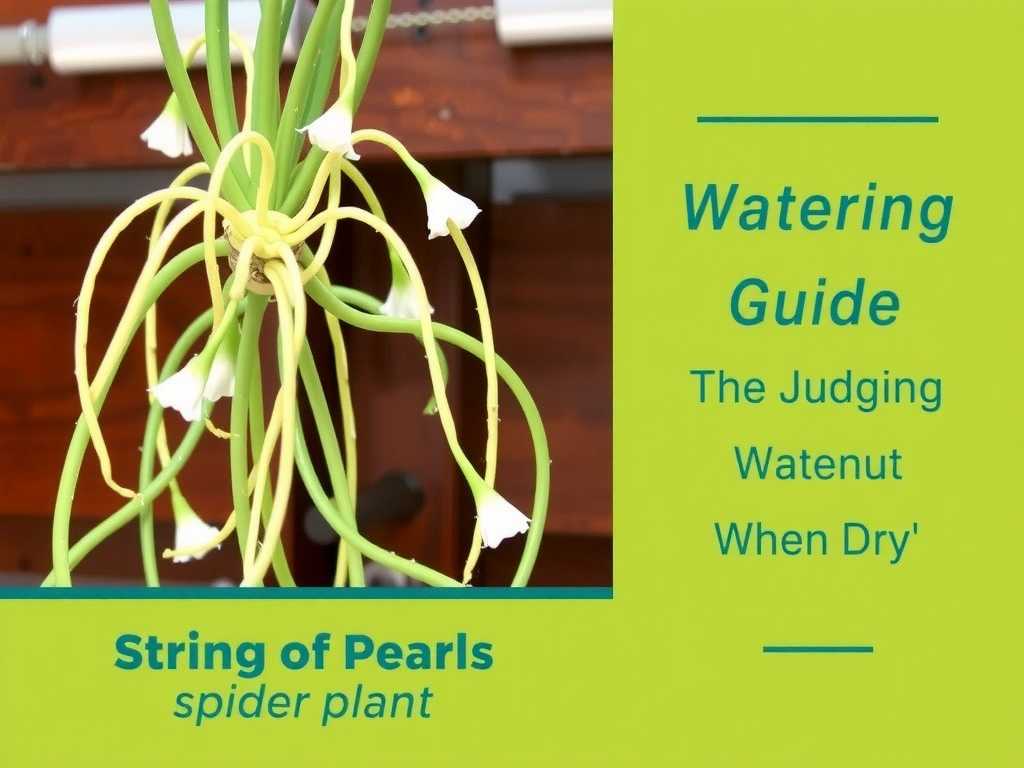
Step 2: Inspect the Windows. Look closely at a pearl. See that thin, translucent line? That's a "window" for light absorption. When the plant is fully hydrated, this window is plump and wide. As it thirsts, the pearl uses internal water, causing the window to thin, narrow, and sometimes appear slightly pinched. Don't wait for severe shriveling—the first sign of narrowing is your cue.
Step 3: Perform the Gentle Pinch. Gently squeeze a pearl near the soil (not on a young, tender tip). A well-watered pearl is very firm. When it's ready for water, it will have a slight, gentle give—like a slightly under-inflated basketball. It should not feel mushy or look shriveled.
When all three signals align—light pot, narrowed windows, and slight give—it's time to execute "water thoroughly."
How to "Water Thoroughly" Correctly
This is the second half of the equation. "Thoroughly" doesn't mean a casual splash.
- Take it to the sink. Place your pot in the sink or a basin.
- Water slowly and evenly. Pour room-temperature water evenly over the soil surface until you see water streaming freely out of the drainage hole. Pause, let it absorb for a minute, then do it again. This ensures the entire root ball is saturated, mimicking a good desert rain.
- Let it drain completely. Leave the pot in the sink for at least 30 minutes to let all excess water escape. Never let the plant sit in a saucer of water. This is non-negotiable for preventing root rot.
The Pitfalls I Encountered and How to Fix Them
The Pitfall: Assuming Uniform Drying. My biggest mistake was assuming all my plants dried at the same rate. A plant in a terracotta pot dried faster than one in glazed ceramic. A plant in direct morning light thirsted quicker than one in bright indirect light.
The Solution: Judge Each Plant Individually. Never water on a schedule. Adopt the judgment method for each plant, every time. Your bathroom String of Pearls will have a different rhythm than your kitchen one.
The Pitfall: Misreading the "Windows." Initially, I confused the natural, slightly pinched shape of some pearls with thirst. I also failed to check multiple pearls along the strand.
The Solution: Check Multiple Sources. Always check several pearls from different parts of the plant—some near the soil, some in the middle of a strand. Look for a collective trend, not just one pearl's state.
The Pitfall: Inadequate Drainage. Early on, I used a decorative pot without a hole, relying on a layer of pebbles at the bottom. This is a death sentence. The RHS explicitly states that "drainage layers" in pots without holes do not prevent waterlogging at the root zone.
The Solution: Use Pots with Holes, Always. Repot into a container with at least one drainage hole. Use a fast-drying succulent/cactus mix, and consider adding extra perlite or pumice for grit.
Your Questions, Answered
How often should I expect to water my String of Pearls? There is no fixed schedule. In my typical indoor setting (65-75°F, moderate humidity), the "water thoroughly when dry" cycle using my method averages 10-14 days in summer and 3-4 weeks in winter. Your environment will dictate your timeline.
My pearls are shriveling, but the soil is damp. What's wrong? This is classic root rot. The roots have died and can't absorb water, so the plant shrivels despite wet soil. Stop watering immediately. Unpot the plant, remove all black/mushy roots and stems, let the healthy parts callous over for a day, and replant in fresh, dry mix. Wait a week before lightly watering.
Is bottom watering a good method for String of Pearls? It can be, but use it with caution. Bottom watering (setting the pot in a tray of water) ensures the roots get moisture, but you must still use the "dryness" judgment methods first. Only leave the pot in water for 15-20 minutes, then remove and drain. Never let it sit in water perpetually.
Mastering the String of Pearls watering guide comes down to replacing vague advice with specific, multi-sensory observations. By learning to accurately judge when the soil is truly dry through weight, visual cues on the pearls themselves, and tactile feedback, you transform "water thoroughly when dry" from a frustrating mantra into a simple, actionable ritual. It’s a shift from reactive, often damaging care to proactive, nurturing understanding. Give these methods a try for your next watering cycle—your cascading strands of plump, happy pearls will be the best reward.





